
Planning a trip to Thailand in 2026 means dealing with two things: the visa rules and the new Thailand Digital Arrival Card (TDAC).
This guide breaks down exactly what you need to know, with practical tips to avoid surprises at the border and prepare for smooth entry.
Quick Entry Summary
If you only want the essentials, here's what matters:
- Update effective May 19, 2026: Visa exemption for most Western passport holders is shortened from 60 days to 30 days.
- The Thailand Digital Arrival Card (TDAC) is mandatory
- Your passport must have at least 6 months validity
- Immigration may ask for a return/onward ticket
- Proof of funds is rarely checked — but legally required
If that's enough to get you started, you're all set. But if you'd like to feel extra confident at check-in and immigration, read on.
1. Do You Need a Visa to Enter Thailand?

Most visitors to Thailand enter using visa exemption, which allows nationals from 93 countries to stay without a visa in advance. Since May 19, 2026, most Western passport holders now get only 30 days under this exemption, down from the previous 60 days.
These countries include the United States, Canada, Australia, the United Kingdom, and most European nations.
If you're planning a typical 1–4 week holiday, visa exemption is usually all you need.
Thailand offers several different entry options depending on how long you plan to stay. For most first-time travelers, visa exemption is the easiest and most common option.
| Entry Type | Typical Stay | What It Means for You |
|---|---|---|
| Visa Exemption | 30 days (extendable 30) | Travelers from many countries can enter Thailand visa-free for tourism. For most vacations, this is the simplest option. |
| Visa on Arrival (VOA) | 15 days | Available for certain nationalities. You'll need hotel details, a return ticket, and the VOA fee on arrival. |
| Tourist Visa (TR) | 60 days | Apply in advance if you plan to stay 2+ months or want more predictability. Useful if you don't qualify for visa exemption. |
| Long-Term Visas | Months to years | Visas such as Destination Thailand Visa (DTV), Non-O, or Thailand Privilege Visa are designed for people planning longer stays, remote work, retirement, or frequent visits. |
FAQ about Visa Exemption
Is there a limit on the number of visa-exempt entries?
There is no official rule limiting how many times you can enter Thailand using a visa exemption in a year.
However, immigration officers may look more closely at travelers who spend long periods in Thailand or make repeated back-to-back visits.
How long can someone stay in Thailand per year using visa exemptions?
Thailand does not publish an official yearly limit.
However, many immigration experts suggest keeping visa-exempt stays under roughly 150–160 days per year to avoid extra scrutiny at the border.
This isn't a formal rule — just a common guideline based on how immigration tends to evaluate travel patterns.
And does immigration automatically reset those entries each year?
No. Your immigration history does not automatically reset each year.
Thailand's immigration system keeps records of your previous entries. Officers may look at your overall travel pattern, especially if you spend long periods in Thailand across multiple years.
Visa rules don't change often, but they do occasionally update, so it's still a good idea to double-check the latest requirements before your trip on the official visa page of the Thai Ministry of Foreign Affairs.
2. Documents to Prepare Before Entering Thailand
Out of everything you need to prepare, the one document people most often forget (but definitely shouldn't) is the Thailand Digital Arrival Card (TDAC).
Here are the key documents airlines and immigration may check before you enter Thailand.
1) Passport validity
Make sure your passport is valid for at least 6 months from the date you enter Thailand.
Airlines usually check this at check-in, and immigration officers will verify it again when you arrive.
2) TDAC: Thailand Digital Arrival Card (mandatory)
From May 1, 2025, TDAC replaced the old paper TM6 arrival card.
- All non-Thai nationals are expected to complete TDAC online before entry, whether they arrive by air, land, or sea.
- It must be submitted within 72 hours (3 days) before your scheduled arrival time in Thailand.
- It is an additional entry requirement; it does not replace your visa or visa-exempt status.
- It's completely free.
I'll walk you through the full TDAC process in the next section.
3) Proof of onward travel (Return or Exit Ticket)
Travelers are officially expected to show proof that they will leave Thailand before their permitted stay ends.
Can I Enter Thailand With a One-Way Ticket?
Airlines tend to check onward travel more strictly than immigration officers.
If you're entering Thailand under visa exemption and only have a one-way ticket, the airline may refuse boarding unless you can show proof that you will leave Thailand within your permitted stay.
From my own experience flying to Thailand many times, airline staff often ask to see my onward ticket at check-in. A printed ticket or a confirmation on your phone is usually fine.
4) Proof of funds
Thailand officially requires travelers to show they have enough money to support their stay.
Typical minimum amounts often cited are:
- 10,000–20,000 THB (USD 280–560) per person
- 20,000–40,000 THB (USD 560–1,100) per family
Proof may include:
- Cash in Thai baht or major foreign currency
- Recent bank statements or banking app screenshots
- Credit card with available limit
Do I really need to carry 20,000 THB in cash?
Not everyone is asked to show proof of funds.
I've personally entered Thailand more than ten times and have never been asked to show money — but I still make sure I can show something if needed.
If immigration officers do ask and you cannot show any funds, they have the authority to refuse entry. So it's better to be prepared, even if you never end up needing it.
5) Visa-exempt, Visa-on-Arrival, and tourist visas
Visa rules do change, and they vary by nationality. If your situation is unusual like long stays, frequent entries, or special visas, it's worth double-checking with a Thai embassy or your airline before departure.
3. Submit Thailand Digital Arrival Card (TDAC)
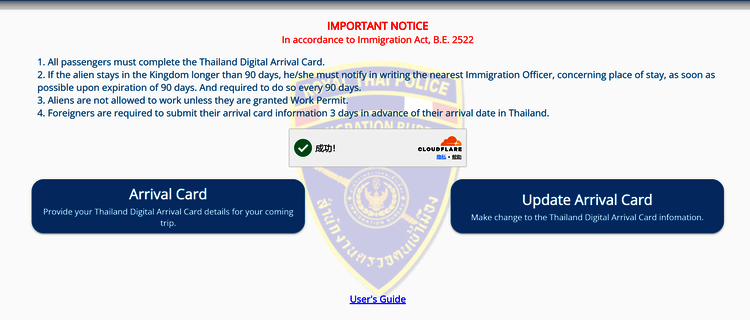
It's mandatory for all foreign travelers (with a few exceptions, such as diplomats) before entering Thailand. Here's what you need to know:
1) When Do You Need to Submit It?
You can only submit it within 72 hours before your arrival time in Thailand.
So:
- Not earlier than 3 days before landing
- Ideally, 1–2 days before departure
If you try too early, the system simply won't accept it. Personally, I set a reminder on my phone 48 hours before departure so I don't forget.
Some travelers have completed it at the airport. But depending on airport Wi-Fi when your gate is boarding? I wouldn't risk it. Airlines may deny boarding if it hasn't been done.
2) Is TDAC Free?
Yes. Completely free.
If a website asks for payment, you are on a third-party or scam site. Always submit via the official Thai Immigration portal only.
3) What Information Do You Need?
The form is simple and takes about 5–10 minutes. You'll fill in:
- Passport details
- Flight number
- Accommodation address in Thailand
- Contact information
If you haven't finalized your full itinerary, just enter your first night's hotel.If you're staying with friends, use their address.
That's it. No document uploads. No payment.
If you make a mistake, the simplest solution is usually to submit a new form with corrected details. The system records the most recent valid submission.
4) What Happens After Submission?
You'll receive a QR code by email. I recommend taking a screenshot and saving it. At immigration, showing it on your phone is accepted. As a backup, you can also print it if you prefer.
5) What Happens If You Forget TDAC?
If you arrive without a completed TDAC, you may be asked to submit it before being allowed to proceed through immigration. It can cause delays and stress.
Some airlines also check TDAC before boarding. If you don't have it, they may refuse boarding.
In some cases, airline staff may also check TDAC completion before boarding, they may refuse boarding if you don't have TDAC.
6) Do children need to complete the TDAC?
Yes. Every non-Thai traveler, including infants and children, must have their own TDAC submission. Each child's details must match their passport. Parents or guardians can help fill it out, but the system treats each traveler individually, so you can't just submit one TDAC for the whole family.
Tip: If you want a detailed step-by-step walkthrough on filling TDAC, check the official Thai Immigration portal.
4. What to Expect When You Land in Thailand

As long as your documents are ready, entry is usually smooth. Most tourists are processed in just a few minutes. Here's roughly what the process looks like.
Step 1 — Follow the Immigration Signs
After leaving the plane, just follow the "Immigration" signs. At major airports like Suvarnabhumi Airport or Phuket International Airport, the walk from the gate to immigration can take 5–10 minutes.
If you're entering under visa exemption, simply join the Foreign Passports line.
Step 2 — Present Your Passport & TDAC QR Code
When it's your turn, walk up to the counter and present:
- Your passport
- Your TDAC QR code (on your phone or printed)
Most officers probably won't even ask for your TDAC QR code since it's already in their system. But I keep it handy — a screenshot on my phone usually works, and I also bring a printed copy just in case they prefer that.
Step 3 — Fingerprints & Photo
Thailand now uses biometric verification for foreign travelers. The officer will ask you to:
- Place your index fingers on the fingerprint scanner
- Look briefly at a camera for a photo
This step usually takes only a few seconds.
For travelers with children: Fingerprints and photos are generally only for adults; infants and young children are usually exempt.
Step 4 — Possible Questions
Many travelers are't asked anything. But occasionally immigration officers may ask a few basic questions, such as:
- How long are you staying in Thailand?
- Where are you staying?
- When is your return flight?
Just answer simply and confidently.
For example:
- "Two weeks."
- "I'm visiting Bangkok and Chiang Mai."
- "My return flight is on the 18th."
You just answer clearly and straightforwardly.
Step 5 — Entry Stamp
If everything looks fine, the officer will stamp your passport.
The stamp shows the date you must leave Thailand by, based on your visa or visa-exempt entry. It's always a good idea to quickly check the date before leaving the counter.
How Long Does Immigration Take?
At major airports like Suvarnabhumi Airport in Bangkok, wait times typically range from 10 to 40 minutes for most travelers. During busy arrival waves — especially late afternoon and evening when many international flights land — queues can occasionally stretch to 45–60 minutes.
At smaller airports such as Chiang Mai or Phuket, the process is often faster, though it can still slow down if several flights arrive at the same time.
When Travelers Are Sent to Secondary Screening?
Sometimes immigration officers may ask travelers to step aside for secondary screening.
This simply means they want to review your travel situation more closely. It doesn't automatically mean you've done anything wrong.
The most common reasons include:
1) Frequent visits to Thailand
If you've entered Thailand many times in a year — especially using visa exemption repeatedly — officers may want to confirm you're genuinely visiting as a tourist.
2) Back-to-back entries
Leaving Thailand and returning immediately (often called a "border run") can attract additional scrutiny.
3) Unclear travel plans
If you can't explain where you're staying or how long you plan to travel.
4) Missing supporting documents
For example, no return ticket or no accommodation details when asked.
In most cases, once everything looks reasonable, travelers are admitted without further problems.
Common Reasons Travelers Are Refused Entry?
Actual refusals are relatively rare for genuine tourists, but they do happen.
The most common reasons include:
1)Overstaying on a previous visit
If you previously stayed beyond your permitted date, immigration may deny entry on your next visit.
2) Trying to live in Thailand using visa exemption
Visa exemption is designed for tourism. Repeated long stays using back-to-back entries can lead to refusal.
3) No onward or return ticket
Immigration wants to see that you plan to leave Thailand before your permitted stay ends.
4) Suspicious travel patterns
For example, multiple long stays with very short gaps between visits.
My Personal Habit for a Smooth Entry: I always print my return ticket, hotel bookings, and itinerary, TDAC QR code, and bring Proof of funds. Immigration has never asked me to show most of these, but having them ready always gives me peace of mind.
5. Multiple Entry & Border Run Tips
Some travelers wonder if they can extend their stay in Thailand by leaving and immediately returning—a practice often called a "border run." Here's what you need to know:
1. Occasional re-entries are usually fine
If you make one or two short trips in a year, immigration generally lets you in without issue. Keep your total days reasonable and always have proof of onward travel.
2. Frequent back-to-back entries may trigger scrutiny
Immigration officers have discretion. Doing multiple border runs or consecutive short stays can lead to secondary screening, extra questions, or occasionally being denied entry.
3. Want to stay longer safely?
Instead of relying on repeated visa exemptions, look at official options like a tourist visa, Non-O visa, or the Destination Thailand Visa. These let you stay longer without worrying about being stopped at the border.
6. FAQ About Thailand Entry
Q: Can I enter Thailand with a single-entry visa if I plan multiple stops?
A: With a single-entry visa, you can only enter once. If you leave and want to come back, you'll need another visa or rely on visa exemption. Doing a few short trips in a year is usually fine, just don't stretch your total days too much or you might get a few questions at immigration.
Q: What happens if my return flight is delayed or I miss it?
A: Immigration cares that you have a confirmed onward ticket when entering. If your flight is delayed, it usually doesn't affect your visa exemption or tourist visa, but overstay rules apply if you remain beyond your allowed date.
Q: Do I need to declare cash or valuables?
A: Travelers carrying more than 20,000 USD (or equivalent) in cash must declare it. For most tourists, small amounts of cash or credit cards don't require declaration, but it's good to check airline and Thai customs rules before travel.
Q: Are land borders processed the same as airports?
A: Mostly yes — you still need a valid passport, visa exemption or visa, and TDAC (for air, land, or sea). However, some border posts may take longer, and biometric scanning may not be as fast as at major airports.
Q: Do I need travel insurance to enter Thailand?
A: Not mandatory for entry, but strongly recommended. Some airlines may ask for proof of insurance during check-in, especially during pandemics or for certain types of visas.